About the programme
Is this for Islamic bankers or conventional bankers?
Both. Basel applies to every bank, and the programme covers how conventional and Islamic banks meet the same standard. The special focus on Islamic banking and finance gives conventional bankers a perspective they rarely get, and gives Islamic bankers the full Basel picture.
I’m not in risk or finance. Will I keep up?
Yes. The programme is designed at three depths: overview for boards and senior management, working knowledge for relationship, credit, audit and compliance teams, and deep for risk, finance, treasury and regulatory reporting. Concepts are explained from first principles with real numbers, not jargon.
I’m a Shariah scholar, not a banker. Why should I learn Basel?
Because Shariah decisions move capital ratios. Whether profit-sharing investment accounts truly absorb losses, and whether a sukuk can count as bank capital, depends on how they are structured and approved. Scholars who understand Basel can see the prudential consequences of the structures they approve, and read the numbers their boards are given.
Does Basel III actually apply to Islamic banks?
Yes, no and partially, and that is exactly what Day 2 unpacks. Islamic banks in most jurisdictions report under Basel-based rules, adapted through the Islamic Financial Services Board’s standards, including IFSB-23 on capital adequacy. The treatment of profit-sharing investment accounts and the “alpha” factor can change an Islamic bank’s capital ratio significantly.
What is the difference between Basel III and Basel 3.1 (“Basel IV”)?
Basel III, introduced after the 2008 crisis, strengthened the quality and quantity of capital and added leverage and liquidity ratios. Basel 3.1, often called “Basel IV”, finalises those reforms: it revises how risk-weighted assets are calculated and introduces an output floor that limits how far internal models can reduce capital requirements. The programme covers both, and what the changes mean in practice.
Is the case study based on real banks?
Yes. It is drawn from GCC central bank reporting and the published Basel disclosures of a conventional and an Islamic bank, so you work with real ratios, not textbook examples.
Is this only relevant to banks in the GCC?
No. Basel is a global standard, and the IFSB standards apply to Islamic banks worldwide. The GCC case study is a practical lens; the principles apply in Asia, Africa, Europe and beyond.
Joining and the credential
Which platform will the sessions run on?
Zoom. Joining details are sent to registered participants before Day 1. You only need a computer or tablet with a stable internet connection.
What language is the programme in?
English, with key Islamic finance terms explained in Arabic where helpful.
Will the sessions be recorded?
Live attendance is strongly recommended: the discussion and Q&A are where much of the learning happens. Please email us if you may miss part of a session.
How do I earn the Credly badge?
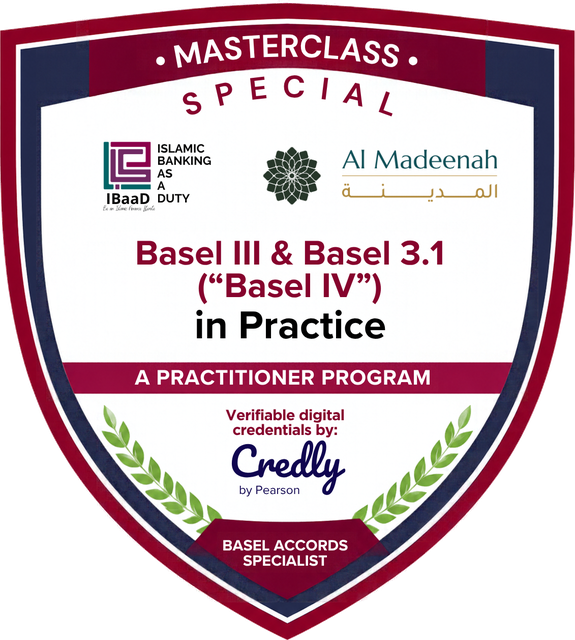
Attend both days and complete the post-assessment. You will then receive the “Basel Accords Specialist” digital badge through Credly by Pearson and a certificate of completion. You can share the badge on LinkedIn, and anyone can verify it online.
Can I ask questions during the sessions?
Yes. Each day includes time for questions, and the keynote is followed by a moderated Q&A.
Fees and payment
How do I register and pay?
Use the registration form on this page. You can pay online straight away by card, KNET or Apple Pay, or ask for an invoice. You can also email team@ibaad.academy or WhatsApp +965 6998 9673. Payments are made to Al-Madeenah Economic Advisory Company WLL, the programme organiser.
Can my bank pay by invoice?
Yes. Choose “Send an invoice to my institution” in the form and we will email an invoice from Al-Madeenah Economic Advisory Company WLL. Teams of 3 or more from the same institution receive 20% off.
Who qualifies for the complimentary Shariah scholar seats?
Shariah scholars currently serving on the Shariah boards of Islamic banks and financial institutions. Five seats are available, awarded on board role, relevance and regional spread. Apply by 5 December 2026.
What if I can no longer attend?
If you cancel at least 7 days before the programme, you receive a full refund less payment charges. After that, you can transfer your seat to a colleague or to a future run. If the organisers cancel the programme, all fees are refunded in full.
Can you run this programme in-house for our bank?
Yes. The programme can be delivered in person or online for a single institution, built around your own bank’s disclosures. Contact team@ibaad.academy to discuss.